
- the hunter in the snow

Ekphrasis/
Below knife-edged peaks smothered in snow
A quaint town
Marked with tavern and steeple intersects
An ice-covered lake in the shallow river valley
dotted with villagers and children who skate and play beyond
A frozen mill.The stage of the foreground,
A hill
overlooking the village with no conceivable path downwards.
On the left, atop the hill,
strong-statured hunters
Furnished with spears
trudge through thick white snow. Among the hunters
Their dogs
Tails and heads pointed down toward the slushy footprints that mark their path
Through tall and leafless trees where five ravens sit.To the left of the hunters upon the same hill,
Sits an inn with a broken sign above its entrance.
Three women tend to a blazing and overgrown
Bonfire treacherously close to the door of the innAt the rightmost edge of the hill
A thin and wispy bush
Perseveres through a barely thawed patch of muddy snow
Capsules of enclosed spring seeds and thorns mark its scrawny stemsTranslucent layers of smoke rise from the chimneys of the idyllic village.
A magpie glides between the layers of haze
Center-frame
Overlooking the totality of this wintery landscape.Postscript/
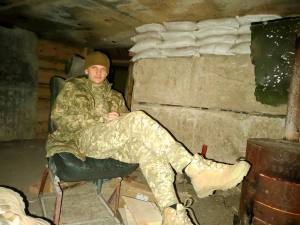
The terrors of war had a marked impact on Andriy. In his own words, pieces of his soul were lost overtime. What was not lost was his dignity and posture as provider and as servant.
When I look at this painting I see Andriy in the hunters and I see the life he hoped to live in the idyllic village. Furthermore, I see the place Andriy no longer felt a part of. In our last conversation together, Andriy told me he didn’t really like his short visits back to Rivne. He felt out of place, burdened, and detached. The war created two realities for Andriy, one where he provides within the village as a fellow, and another where he is a shadow. A silhouette.
The women beside the inn throw tied bails of wheat onto a rabid fire–a picture of absolute chaos. This, to me, represents the world Andriyy saw through the war: people suffering and adding to their own suffering.
I also see the longing to belong in the village in the hunters still trudging toward the village which reminds me of Andriy’s decision to continue to serve despite his desire to work as a doctor in the States. This is what grieves me most in this painting, the disappearing horizon of the cliff side that separates the hunters from the village. Andriy deserved this life in the village, one of peace and tranquility fulfilling his purpose as a protector for a long life. He studied countless hours and worked harder in more difficult conditions than anyone; yet, his dreams have been cut short at the cliff side. The hunters walk to the cliff side knowing there is no path into the village. Andriy, in his final act on this earth, knowingly walked toward death in an effort to save the lives of others.
The valley in this painting sits in the shadow of an impregnable mountain range, hazardously sharp, warning others not to dare leave. This, to me, is a reality the villagers can see but do not confront.
I see God in the magpie, hovering over all, cutting through thinly veiled smoke. There is an absent look in its eyes, one of an observer, incapable of or unwilling to make an impact.Yet, in this winter landscape, I am reminded that grief is a season and the realities and feelings of this season should not be ignored.
- the hunter in the snow
- inasmuch i am speechless
- i, who MADE THE MOUNTAIN
- the curtain
- LA
- CHRIST / brother
- CHRIST / rest in my arms
- CHRIST / blessings
- tumultuary
- ATTA SOL i
- MA FLORA i
- writing ‘blood of love’
- Kanye West: Jesus is King
- Angel by Massive Attack
- decidedly yours
- importance over penance under forgiveness over ignorance under importance
- blacksnow in Spring
- the noise was terrible
- ‘little hope’
- wire
- mast
- an antique desk that represents moving on
- writing ‘silhouette’
- photography by Franco Fontana
- writing ‘Ecce Homō’
- Avril 14th by Aphex Twin
- photography by Michiko Chiyoda
- writing ‘effort’
- what a beautiful refrain
- the lent between ocean and shore
- Kristof
- receive me, brothers
- i’ve got to be it’s got to be
- you can make anything of it
- the woods
- the lakes
- simsalabim
- this wonderful design _ 3
- i’ve got you on my mind, giver _ 2
- godspeed, you animals! _ 1
- そして私は走った
- memory gospel
- how do i know you
- Second of May
- this is easy for me to say
- some strange sounds
- filaments
- P E O P L E – imitating strangers
- P E O P L E – let me feel it out
- -poems for Tanya
- -poems for Tanya
- -poems for Tanya
- bystanders pt. 2
- apartments
- my wilderness in simplicity
- 6103 //
- lyric of fire
- tour america
- Child.
- silhouette
- -, secret society
- in talks, –
- euphony in light of semantics
- himna smiður / SMITH OF THE HEAVENS
- effort
- November
- bystanders
- Þess á milli / lyric of familiarity
- skeletons
- animals
- we walk
- eagerly please
- i’m the less likely
- -ANALOGOUS HYMNALS Pg. 03
- -ANALOGOUS HYMNALS Pg. 13
- -ANALOGOUS HYMNALS Pg. 23
- -, Tjú
- Ichor to Ferry Love, –
- FE. MDLXIII. / In Death Mine’s the Fury
- -, Rota Fortunae
- Mirrors for Princes, –
- -, Bona Dea / Rejoice! Rejoice!
- Flōra / Hark!, –
- -, We
- We, –
- Regarding Norway / пічка
- The Fall of Dignity / sykophántēs
- Desert
- FE. MDLXVIII. / Expression of Being
- Ecce Homō
- -‘ Somber
- Viscous ‘+
- – , Netherlandish Execution / Nikódimos
- álas Blood, –
- Drought of Man / Diarkí̱s
- Vitals
- Unbridled
- The Møring Queen
- Prince of Normandy
- The Lyric of a Shared Winter
 TUMULTUARY